When it comes to protecting the sanctity of a boardroom or a classified briefing room, the most sophisticated software in the world can be bypassed. That is why the answer to mobile eavesdropping isn’t a better app, it is physics.
The Failure of Digital Policies and Signal Jammers
For years, organizations in the government, military, and critical infrastructure sectors have relied on two primary methods to secure their meetings: digital policies and signal blocking.
- Digital Policies: Relying on “Do Not Disturb” modes or MDM (Mobile Device Management) software is a gamble. If a phone is compromised by high-level spyware, the operating system itself can no longer be trusted. A microphone can be activated remotely, recording audio locally even if the phone appears to be “off” or in a secure mode.
- Signal Blocking: Jammers and Faraday cages are common but flawed. Jammers are often illegal due to interference with emergency services and critical infrastructure. Faraday bags stop transmission but do not stop a device from recording audio to its internal storage for later upload once the device leaves the secure area.
Shield: A Purely Physical Countermeasure
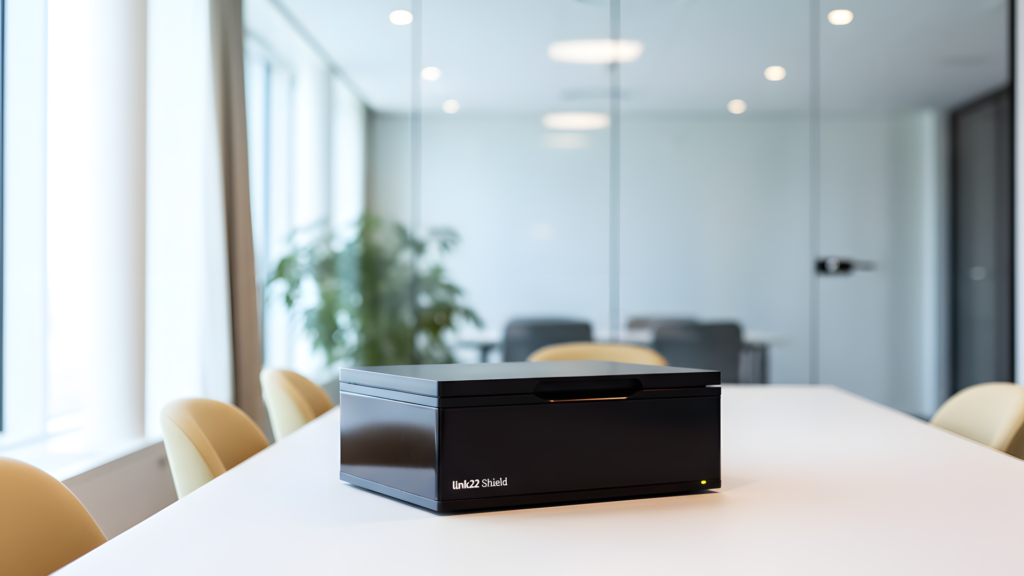
link22 Shield was designed to eliminate these variables. By moving away from software-dependent security, Shield restores absolute control to the user.
"Shield is purely physical. It can't be bypassed by software, and because it's a standalone device, it doesn't depend on networks or updates. It just works."
As a standalone noisebox, Shield provides a controlled acoustic environment. When a device is placed inside, it is physically isolated from the room’s sound environment. Even if a phone is actively recording, it is no longer “hearing” the conversation in the room; it is only hearing the randomized, modulated noise generated by the Shield’s internal sound masking system.
Why "Simple" is the Ultimate Security Standard
In high-stakes environments like R&D or defense, complexity is the enemy of security. Complex systems require updates, training, and constant monitoring, all of which create windows of opportunity for failure.
Shield removes these layers of friction. There is no software to patch, no network to configure, and no training manual required. It is a soundproof box for phones that fits naturally into existing security routines. You place the phone in, close the lid, and the threat is neutralized.
Conclusion
In an age where our most essential tools, our smartphones, are also our most significant vulnerabilities, we must protect the one thing that cannot be encrypted: human conversation. link22 Shield offers a wall between the digital world and physical reality, ensuring that your most sensitive discussions remain secret.
Read more and book a demo here.